


It’s all about pyramids
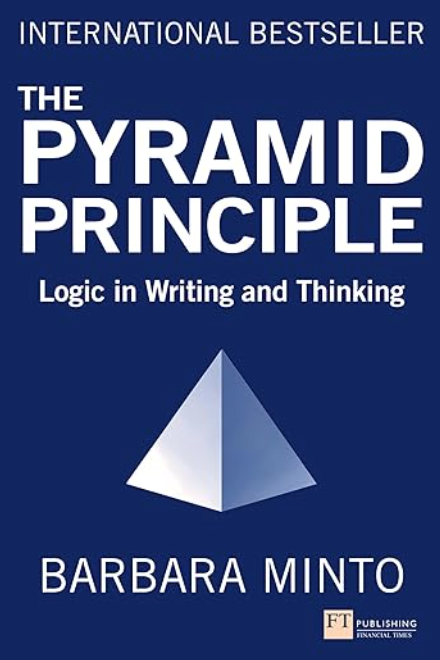
In my recent blog series, I’ve been writing about tips and techniques to help you get started with your own writing. Before we move onto the next series, I wanted to share with you one tool that will help with your writing. In this case, it is a book that I’ve mentioned a few times in various blogs: ‘The Pyramid Principle’ by Barbara Minto.
The book is a little dated, but the principles are as good today as they were in 1985, when she wrote it.
Minto was a consultant with McKinsey when she first developed this method. It’s a powerful way of organising ideas for written reports, making them easier to understand. In essence, the concepts revolve around the brain’s ability to better remember and understand things that are presented in groups of three, four, or five, progressing from summary to detail.
Why a Pyramid?
 The best way to explain this is by thinking of a shopping list. When you create a shopping list, it’s usually in the order in which you ran out of items around the house (or when you remembered that you needed them):
- Fish
- Toothpaste
- Light bulb
- 6″ nails
- Black tights
- Card for Sam
- Pay cheque in
- Furniture polish
- Pork chops
- Cabbage
When you actually go shopping, you group them first by the shops you’ll be buying them in (supermarket, hardware, clothing, bank) and then, maybe, subdivide them by type (dairy, meat, household).
That subdivision upon subdivision creates a pyramid structure, and it’s a powerful way to create articles, blogs, emails, and any other type of content. To build your pyramid, Minto explains 2 approaches:
The bottom-up approach
If you start from the bottom of your pyramid, you first grab all the ideas. You don’t try to order or structure them – you just write them down. We did this in my blog, Let it all Hang Out. It’s great when you have lots of ideas you want to share and can’t see the wood for the trees to make it simple for an audience.
The top-down approach
When you start from the top of your pyramid, you begin by thinking about the one single point you want a reader to grasp. I explained this in more detail in my blog, Structure your ideas from a single point This is good to use when you know what you want to say and now need to make a case to support it with your audience.
What’s important to remember with The Pyramid Principle is that the process is iterative. You may start at the top, find that you’re getting lots of ideas to work with, organise them bottom up, see the patterns and then rearrange the top to make a stronger case. You go over it until you have a well-formed structure, with all the ideas you need and nothing extra which doesn’t add value.
And now you write
Once you have that structure in place, you then sit down and write. Because you’ve thought about it carefully, the writing process becomes a good deal easier. Simple even.
And, if you’ve got an article that you’ve already written, which doesn’t seem to be ‘working’, you can apply the Pyramid Principle in reverse. You can use the concepts to find all the structural elements and see where gaps and missteps occur in your thinking. Minto even provides examples of different types of writing and illustrates how the principles apply.
One final thing….
The Pyramid Principle is a great book, and the method works really well in most cases. It does, however, take practice. So be prepared to work at it and take the time it requires to build your skills. Give it the time and effort it deserves, and you’ll soon be creating perfectly pyramidic content!









Leave a Reply
Want to join the discussion?Feel free to contribute!