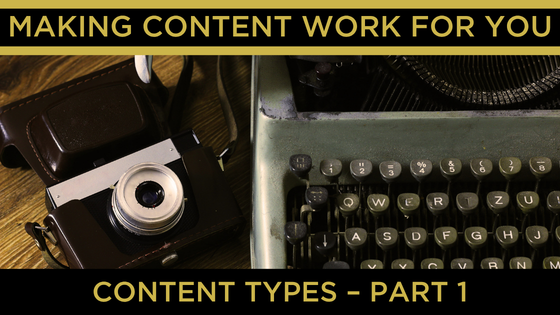

Delving into content types – Part 1
Content is anything which adds value to the audience.
It’s a great definition, but ‘anything’ is such a vague description, so over the next two blogs, we’re going to go into the different types of content and when you might want to use them.
The written word
Written content can take the form of articles, blogs, or e-books. It’s not always about long-form pieces, though; tweets, Facebook posts and flyers are also examples of written content.
An obvious advantage to writing from the get-go is that it’s non-intrusive; the audience can
interact with it at their own discretion and read at their own pace. It’s also portable – books and magazines go with us everywhere, and even web pages can be stored offline so you can move from place to place and keep reading. Video and audio very rarely have this benefit.
Written text is also still necessary in some contexts, often to explain something that would be difficult to do in images or speech.
There are still disadvantages to the written word though.
Firstly, it can take time to develop. No matter your skill level, you could usually get your point across more quickly and easily by speaking rather than writing (and ‘a picture paints 1000 words’).
Secondly, as we’ve discussed in the previous blog series, writing takes practice, and there are many rules around spelling, grammar, and style. So, while producing written content is easy, producing good written content can be a challenge.
Visual content
By visual, I mean static images, such as photos or drawings. They can take the form of photographs (including Stock Images, provided you have permission to use them), drawings, or infographics. Visuals also include memes, which can both entertain your audience and attract new users via likes and comments.
A well-placed image is easily accessible and can tell an instant story. An appropriate image can significantly enhance your content and help break up a sometimes-intimidating wall of text.
There are no complex rules to navigate, and images are often given a higher priority than text in the Facebook algorithm, meaning people are more likely to see your post if it’s accompanied by an image.
Of course, there are still disadvantages to using visuals.
The major challenge is finding the right image. It’s not as simple as just searching for a topic on Google Images. Setting aside the fact that using images you find online is usually an infringement of copyright, you may have to trawl through pages of results to find something appropriate. An image that doesn’t fit the theme can look ridiculous and undermine your other content; for example, people are unlikely to click on an article about how to make the perfect Eggs Florentine if you’ve accidentally attached a picture of an omelette.
The second challenge is that visuals will rarely stand alone. They’ll almost always need text to accompany them.
So, that’s two types of content and in part two we’ll continue this exploration of types.
In the meantime, share below how you’ve used writing or images to add value for your audiences – I’d love to know.
And if you’d like more help with your own content, check out our short course Demystifying Content.




Leave a Reply
Want to join the discussion?Feel free to contribute!